The border-blurring brought on by the Internet must just be driving oppressive regimes nuts. How are you supposed to control what information people get their hands on when it’s coming from the other side of the globe at the speed of light from people beyond the reach of your thugs and laws? Well, many such regimes have adopted the tactics of similarly-minded paranoid conservative parents who don’t know what to make of the Internet. If the source is beyond their control, they can at least attempt to block it at the point of entry.
This puts the foreign companies providing the content in a bit of a pickle. They don’t want to lose their market share in the country in question, but they (hopefully) don’t want to facilitate oppression either. Or, they don’t want to look like they’re facilitating oppression. In fact, foreign companies are in a better position than citizens of the country in question, since they’re able to use their economic clout to influence policies without the same risks and restrictions that domestic actors face. So, striking a balance between these concerns is of great importance to the success and reputation of the company as well as the human rights situation in the oppressive country. Here are some of the options foreign companies have:
Cooperate & Facilitate
Do whatever the oppressive government wants you to. Stop doing things they want you to stop, and give them the information they demand.
Pros: You get to continue operating in the country. Market share and profit and stuff.
Cons: You’re doing evil, and everyone will hate you for it. You could also get in legal trouble in the US.
 Example: Yahoo!, China, 2004. Pretty much the worst possible way to handle this sort of situation. In 2004, the Chinese government released a document warning journalists about reporting on sensitive topics because of the looming 15th anniversary of the 1989 Tiananmen Square Protests. Journalist Shi Tao sent a brief of this document to the Asia Democracy Foundation via his Yahoo! e-mail account. The Chinese government found out and demanded Yahoo! hand over information about the sender. Yahoo! did it without even asking what it was for. As a result, Shi Tao was sentenced to ten years in prison. Yahoo! was criticized by every human rights organization in the book. Congress investigated the incident, and later reprimanded Yahoo! for not giving full details to them regarding the incident. Rep. Tom Lantos (D-CA) told Yahoo! founder Jerry Yang, “While technologically and financially you are giants, morally you are pygmies.” Yahoo! was sued in the US on behalf of Shi Tao and another journalist, and they settled out of court for an undisclosed sum. There still exists a campaign to boycott Yahoo! because of this, and I still refrain from using Yahoo! services. Oh, did I mention they did the same thing two years earlier, resulting in another ten year prison sentence for journalist Wang Xiaoning? And were complicit in helping to convict Li Zhi and Jiang Lijun, two other government critics?
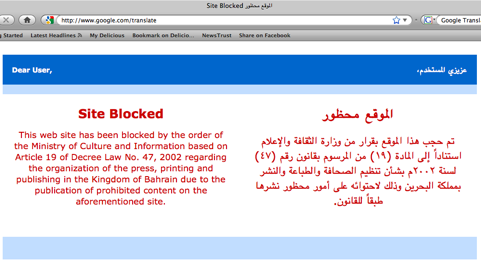
Example: SmartFilter, Middle East. McAfee’s SmartFilter software has been used by governments in Tunisia, Sudan, Oman, the UAE, Kuwait, Bahrain, and Saudi Arabia to block certain Internet content from reaching users. They make no effort to prevent or prohibit governments from using this software, which is allegedly aimed at homes and schools. The software includes a database of more than 25 million blockable websites in various categories. Such filtering databases as well as selective algorithms have been shown time and again to be massively flawed in the categories they attribute to various websites. But, instead of simply inconveniencing a student who wants to research safe sex, AIDS, or religious tolerance (God forbid), it alters the information that can make it to an entire country of Internet users. The OpenNet Initiative also accused Iran of using SmartFilter, though the US’s embargo against Iran would prohibit the sale or licensing of this software to Iran. The company has said that Iran pirated their software. Some say Iran now has its own censorship software. While McAfee doesn’t market their software to oppressive regimes or for the purpose of mass censorship, some selectivity in who they license their software to or the scale at which they allow it to be implemented wouldn’t be a bad idea. It wouldn’t stop governments from pirating it, but at least it would help McAfee from appearing complicit in censorship.
Unfortunately, there are way more examples of this response than any of the responses below.
Cooperate Less
Set a limit to your capitulation while acknowledging the authority of the host government as set out by its laws.
Pros: You might get to continue operating in the country without giving in entirely. You would also help make it clear that there is a limit to what governments can force foreign Internet companies to do.
Cons: The government might still prevent you from operating there. You might not get the benefit of being seen as standing up to oppression.
Example: YouTube, Turkey, 2007. The Turkish government mandated that Turkish telecom providers block access to YouTube because it hosted some videos that were said to insult Mustafa Kemal Atatürk. Nicole Wong, deputy general counsel of Google, which owns YouTube, decided that Google would block Turkish IP addresses from accessing videos that clearly violated Turkish law. Later, though, a Turkish prosecutor demanded that Google block users anywhere in the world from accessing such videos. This is where Google drew the line, and they refused to capitulate to the unreasonable request. YouTube remained blocked in Turkey until 2010 when Turkey’s Transport Minister, in charge of Internet issues, lifted the ban, proclaiming that “common sense prevailed”. So, despite the dismay and limited success of the conservative elements that demanded the ban, internal pressure and the realization of YouTube’s importance prevailed.
Move Services Out of the Offending Country
The more of a company’s operations that physically take place within the offending country, the more power the government can assert over the company. Partnering with local firms presents similar problems. Locating data storage in particular outside of the country allows in-country users to move their data farther from the reach of their government. There are few examples of companies making this kind of drastic business change, but the choices companies make before starting business in other countries affect their relationship to freedom of speech controversies in the future. For example, Google and Microsoft don’t partner with Chinese companies (though they have their own workers in China), whereas Skype and Yahoo do, and the latter companies have lost much more face in controversies surrounding censorship in China.
Pros: It’s likely that the offending country’s government will block your services anyways, but at least the option is there should they choose to unblock them in the future. There’s also the advantage of preserving your reputation and being seen as not doing evil.
Cons: Your services might very well get blocked. Your local workers or former local workers could face trouble.
Example: Google, China, 2010. When Google discovered hacking attempts targeted at the Gmail accounts of Chinese human rights activists, which would put those activists in great danger, they reacted harshly. They announced that they would stop censoring search results on Google.cn, which they had previously agreed to do in order to be allowed to start operations in China. They even went so far as to say that they would shut down their operations in China entirely if the government continued causing problems. While Hong Kong is technically part of the People’s Republic of China, it operates under radically different laws regarding freedom of speech. As is often the case with China’s Internet blocking, the accessibility of Google.cn varies by time and location.
Shut Down Services
No longer offer your services to the offending country and its Internet users.
Pros: You stand your ground, and the offending government will (well…might) think twice before they try to muscle a foreign company again.
Cons: You’re no longer in that country’s market. Whatever limited information or services you were able to provide or would be able to provide are no longer available to users in that country. Your local workers or former local workers could face trouble.
 Example: Websense, Yemen, 2009. Websense, like SmartFilter, is web filtering software similar to SmartFilter. Like SmartFilter, it is not intended or marketed to be a tool for government censorship. Actually, it was what my high school used to ban naughty (and not so naughty) things. But, unlike SmartFilter, Websense has an explicit anti-censorship policy under which it “does not sell to governments or Internet Service Providers (ISPs) that are engaged in government-imposed censorship”. When Websense discovered that the Yemeni ISPs were using their software to implement government-imposed mass censorship, they prohibited Yemeni ISPs from accessing updates to their software.
Ignore the Government
There are a lot of services that presumably carry content that oppressive governments wish to block and have probably requested to have taken down, but controversy rarely arises when companies just ignore those requests. It may be useful to be linked to free speech and democracy movements, as is the case with Twitter. Some users will undoubtably find a way to access your website, and it will be much more valuable to them if, when they get there, there is freedom of speech.
Pros: Like the previous several options, you get some good karma by not giving in to an oppressive government. You remain in control of your content. By not engaging the government, the issue may not go any further, and the government may not end up enraged and looking for a way to get revenge or assert its power.
Cons: You may get blocked. You may get in legal trouble if you ignore government requests.
Example: Twitter. Twitter’s strategy is not even engaging with oppressive governments about getting their website unblocked. They focus more on working on developing ways to circumvent censorship. As Twitter CEO Evan Williams put it, “The most productive way to fight that is not by trying to engage China and other governments whose very being is against what we are about.” By continuing to host politically controversial content, Twitter has become central to many opposition movements. Even though it is at least partially blocked in Iran, many Iranian dissidents communicate using Twitter, and a lot of information makes it out of Iran via Twitter.
I shouldn’t need to explain why it’s bad to help government oppress their citizens. So I won’t. But all too often, the moral repercussions of business decisions like these get looked over because they don’t have overt monetary value. But it’s inextricably linked to reputation, which is inextricably linked to success. Part of Google’s success is that it is seen as not doing evil. In a world where people are increasingly wary of big corporations (see: all those “Occupy” movements right now), it’s important that a company be seen as a friend, not an enemy.


 Yale Law Tech